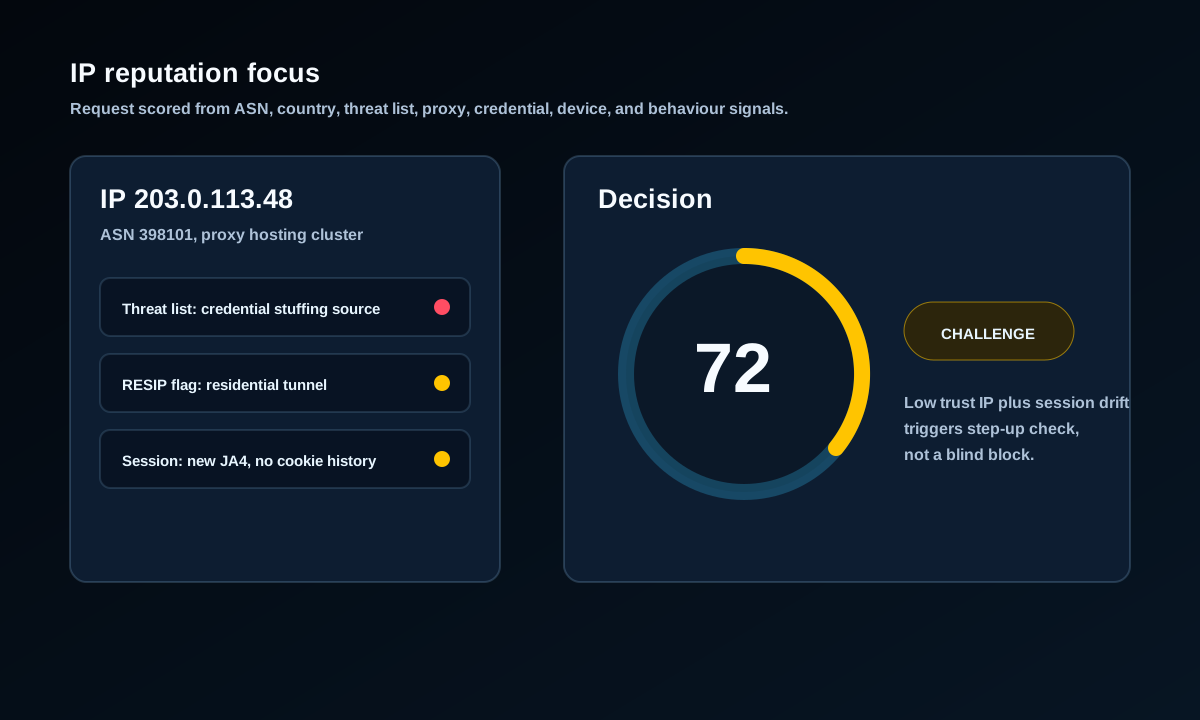
The request is scored before origin processing
Peakhour evaluates incoming addresses against managed reputation sets and request context before traffic reaches application infrastructure.
Each request is evaluated with reputation, proxy status, credential exposure, device history, behaviour, and request context so edge decisions remain reliable when threat infrastructure rotates.
Attack traffic now shifts rapidly across hosting providers, residential proxies, and short-lived infrastructure. Reputation becomes operationally useful when it is interpreted with device, credential, behaviour, and event context in the same decision path.
Botnets, proxy services, and compromised endpoints rotate addresses continuously, so standalone deny lists decay quickly without supporting signals.
Large request volumes make manual analysis impractical unless risk factors are normalized into a single evaluable path.
When teams identify malicious behaviour after origin processing, attackers have already consumed resources and expanded impact.
Peakhour enriches each request with IP reputation and combines it with RESIP, credential, device, behaviour, and event signals so policy can allow, challenge, block, or log with an explainable decision record.
A managed intelligence graph tracks more than 900 million IPs across 22+ categories and updates as infrastructure behaviour changes.
Threat categories can be enforced directly or combined with companion signals for selective challenge, block, and allow behaviour.
Decision outcomes remain attached to their inputs, making tuning, incident review, and downstream security workflows faster and clearer.
IP intelligence is most useful when the request, policy decision, and decision/log output stay connected. This dashboard capture shows the blocklist result beside category, severity, and action code for immediate verification.
Peakhour evaluates incoming addresses against managed reputation sets and request context before traffic reaches application infrastructure.
When the address matches the webattacks list, policy denies the request with an explicit action code rather than an opaque failure.
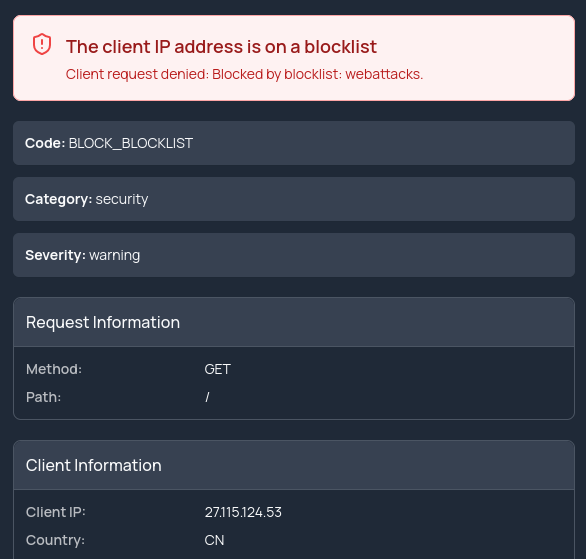
The resulting event preserves enough context for policy tuning, customer-impact review, and export into broader security operations.
Add per-request proxy risk when attackers rotate through consumer networks to avoid reputation-only controls.
Combine IP, proxy, fingerprint, and behaviour signals into bot scores and edge actions.
Apply route-aware policy when suspicious infrastructure targets APIs, tokens, or account workflows.
Related evidence
Customer examples that connect Peakhour controls to production outcomes.

Stone & Chalk
How Australia's leading fintech hub secured hundreds of startups with enterprise-grade application security, zero-day vulnerability protection, and comprehensive threat management.

National Gallery Australia
How Australia's National Gallery achieved government security compliance with advanced bot management, DDoS protection, and content scraping controls whilst improving digital visitor experience.

Discover and block threats through data enrichment using managed IP reputation lists
Read More
An in-depth exploration of the JA4+ network fingerprinting method, its applications, and its role in cybersecurity.
Read More
How fingerprints can enrich threat review, correlation, and response decisions without becoming standalone indicators.
Read More
An in-depth exploration of EPSS, its data-driven approach to assessing cybersecurity threats, and how it complements CVSS.
Read More© PEAKHOUR.IO PTY LTD 2026 ABN 76 619 930 826 All rights reserved.