
Think about how we've talked to computers over the years. At first, it was rigid and unforgiving. The command line expected the exact words, in the exact order. One typo, and you were met with an error. It was powerful, but only once you learned to speak the computer's language.
Then came the graphical user interface, or GUI—the familiar world of windows, icons, and mouse pointers. That changed the relationship. You no longer had to memorise commands before you could do something useful. You could see your options, click on them, and drag things around. It made computers accessible to hundreds of millions of people because it was more intuitive. It was a visual conversation.
But both of these interfaces, the command line and the GUI, share the same basic bargain: we adapt ourselves to the computer. We still have to navigate menus, find the right button, or remember a specific command. We take a goal in our head and break it into steps the computer understands.
What if that translation was no longer mainly our job? What if the computer could understand our goal well enough to work out the steps?
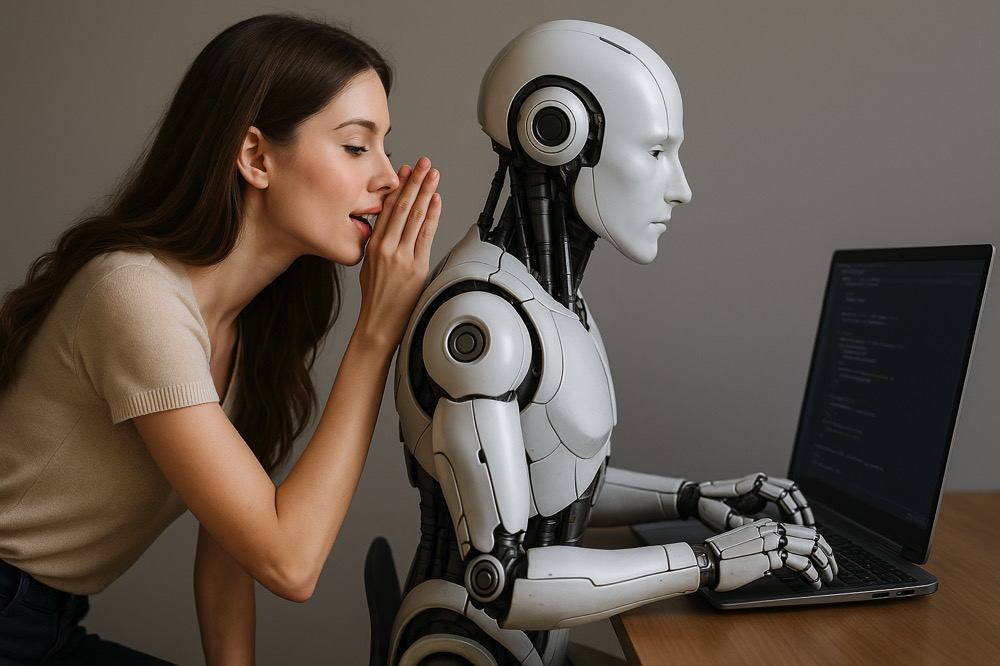
This is the next shift I find interesting, and it is powered by Artificial Intelligence. AI is starting to look less like another application and more like the next major interface. It's not a visual one with buttons and menus, but an intelligent one built on understanding.
The idea is simple, even if the implementation is not: we state our intent, and the AI figures out the steps. Instead of clicking through five different menus to create a sales report, you could just say, "Show me last quarter's sales figures for the eastern region, and visualise it as a bar chart." The AI's job is to understand that request and then do the work: query the database, aggregate the data, select the right chart type, and present it to you. It acts as a translator between human language and the computer's machine language.
We're already seeing the early stages of this. When you ask a smart assistant to play a song, or when an AI co-pilot writes code for you, you're using an intent-driven interface. You're not telling it how to do the task; you're just telling it what you want done.
That shift matters because it moves some of the cognitive load from us to the machine. We no longer need to be experts in using a particular piece of software; we just need to be clear about what we want to achieve. This has the potential to democratise technology on a scale we've never seen before, making complex digital tools feel closer to a conversation than a training course.
The future of computing isn't about learning more complex systems. It's about building systems that can learn from us. The interface of tomorrow won't be something we click on, but something we talk to, correct, and steer. That is the real change: technology that doesn't just follow instructions, but understands our goals.