
For years, rate limiting has been a standard control for protecting websites and APIs from abuse. The basic model is simple: limit the number of requests a single "user" can make in a given period. If a user exceeds the limit (e.g., 10 login attempts in a minute), they are temporarily blocked.
The hard part has always been identifying that "user". Traditionally, the answer was the IP address. The assumption was that one IP address equaled one user. In the early days of the internet, this was a reasonable approximation. Today, that assumption no longer holds, and it leaves systems exposed to modern attacks.
The IP address is no longer a reliable identifier for a single user or device. There are three common reasons:
- Proxy Networks: Attackers don't use a single IP address. They use large residential proxy networks to rotate requests through thousands or even millions of different IP addresses, making each request look like it comes from a new user.
- Shared IPs (CGNAT): At the same time, a single IP address can represent thousands of legitimate users. Mobile carriers use Carrier-Grade NAT (CGNAT) to make many mobile devices share the same public IP. Similarly, an entire office building or university campus might appear to the internet as a single IP.
- Distributed Attacks: Modern automated attacks, like Layer 7 DDoS or credential stuffing, are inherently distributed. Attackers use botnets or proxy networks to spread their attack across a large number of IPs, so no single IP ever exceeds a traditional rate limit.
Blocking a shared IP because of one bad actor can cause collateral damage, denying access to thousands of legitimate users. On the other side, failing to see that thousands of IPs are part of a single coordinated attack means the attack succeeds. Traditional IP-based rate limiting is no longer enough.
The New Way: Advanced Rate Limiting
Advanced Rate Limiting addresses this by moving beyond the IP address. Instead of grouping requests by a single, unreliable identifier, it lets you count requests using more stable and meaningful characteristics of the connection or the software making it.
This approach groups requests using identifiers like:
- TLS/HTTP2 Fingerprints: Every client application (like a browser or a script) has a unique "fingerprint" based on how it initiates a secure connection (TLS) or communicates over HTTP/2. This fingerprint remains consistent even as an attacker rotates through thousands of IP addresses. By rate limiting based on the TLS fingerprint, you can track and block the underlying automation tool itself, not just the IPs it uses.
- Device Characteristics: A fingerprint can be constructed from a range of attributes, including the device's operating system, browser version, and more. This allows for the detection of repeated requests coming from the same class of device.
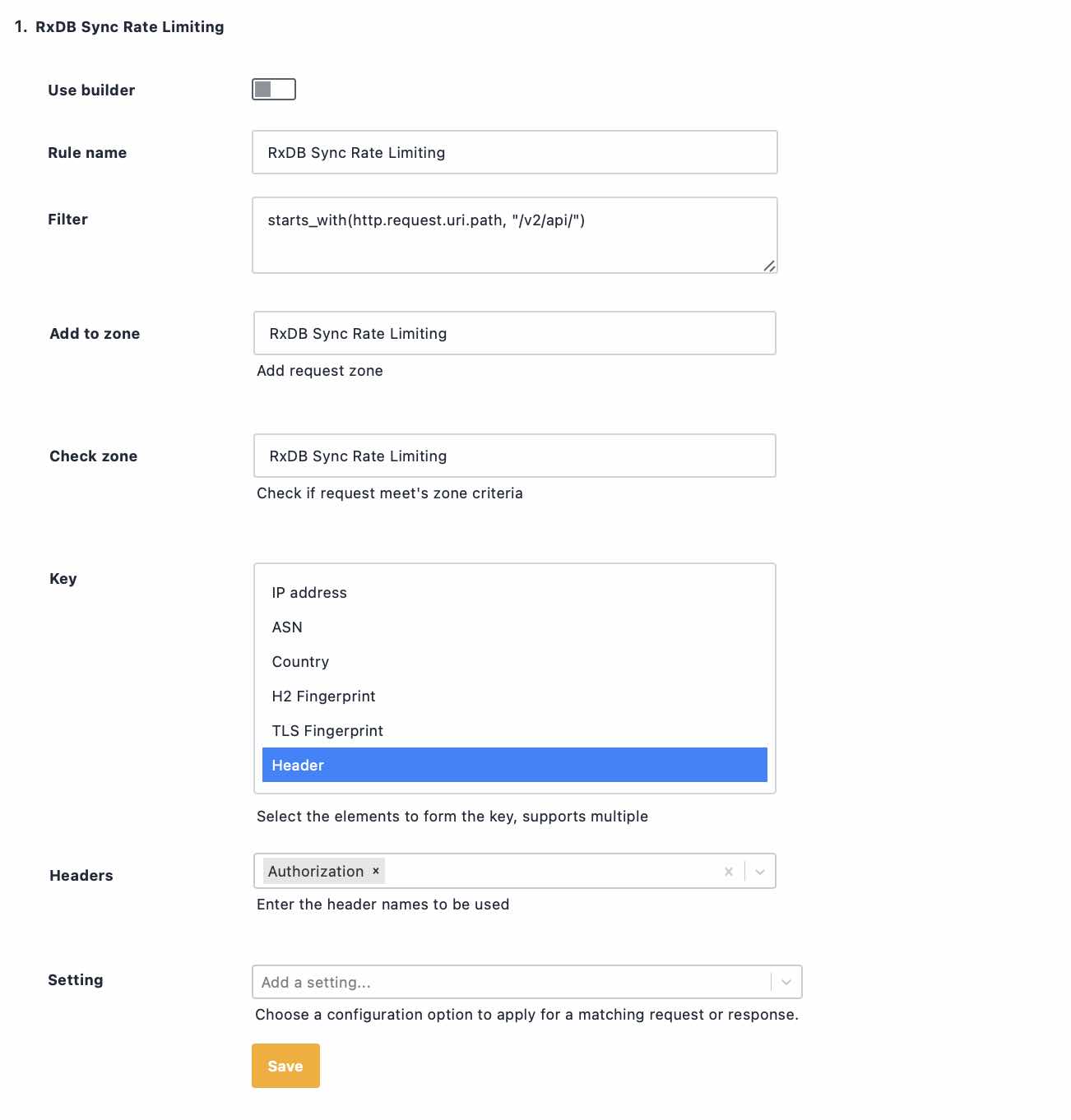
- A Combination of Headers: For authenticated APIs, you can group requests by an Authorization header or API key, enforcing fair usage and preventing abuse by a single authenticated client.
Practical Use Cases
The value of advanced rate limiting is clearest when it is applied to real-world threats:
-
Mitigating Distributed Credential Stuffing: An attacker using a tool like OpenBullet launches a credential stuffing attack against your login page, rotating through thousands of residential proxy IPs. Traditional rate limiting is ineffective here. However, the OpenBullet software has a consistent TLS fingerprint. By setting a rule to limit failed login attempts per TLS fingerprint, you can detect and block the entire distributed attack, regardless of how many IPs are involved.
-
Protecting APIs from Abuse: A partner is abusing their API key, sending far too many requests and degrading service for other users. By rate limiting based on the
Authorizationheader, you can enforce usage limits on a per-client basis, keeping access fair without affecting other users. -
Stopping Content Scrapers: A scraper is hammering your e-commerce site to steal pricing data. They are using a botnet to distribute the requests across hundreds of IPs. However, the scraping script has a unique combination of a user-agent and a TLS fingerprint. Advanced rate limiting can count requests based on this combined signature and block the scraper, protecting your intellectual property.
When attackers are distributed, your defences need to see the single actor behind the many IPs. Advanced rate limiting provides that visibility and should be part of a modern application security strategy.