
A good user experience matters for any website. It matters to users, and Google also measures aspects of the user experience when ranking your website in its organic results.
Google ranks websites and pages in its search results using 'search signals'. These signals include the quality of content on a page, the number of sites linking to that page, and the experience of the user browsing the site. Factors that make up a great experience include ease of use, accessibility, speed and responsiveness.
The set of search signals that Google uses to measure user experience beyond a page's content value is called 'Page experience'. Google updated the Page Experience signals with metrics called Web Vitals.
For years, performance testing used different proxies to determine whether a website was fast. Browser events like 'Page Load' or 'Dom Load' were used before it was realised that these do not necessarily reflect what an end user experiences. Testing then fragmented, with different teams focusing on the measures they considered important. Web Vitals is Google's performance testing initiative to provide "unified guidance for quality signals that they believe are essential to delivering a great user experience on the web."
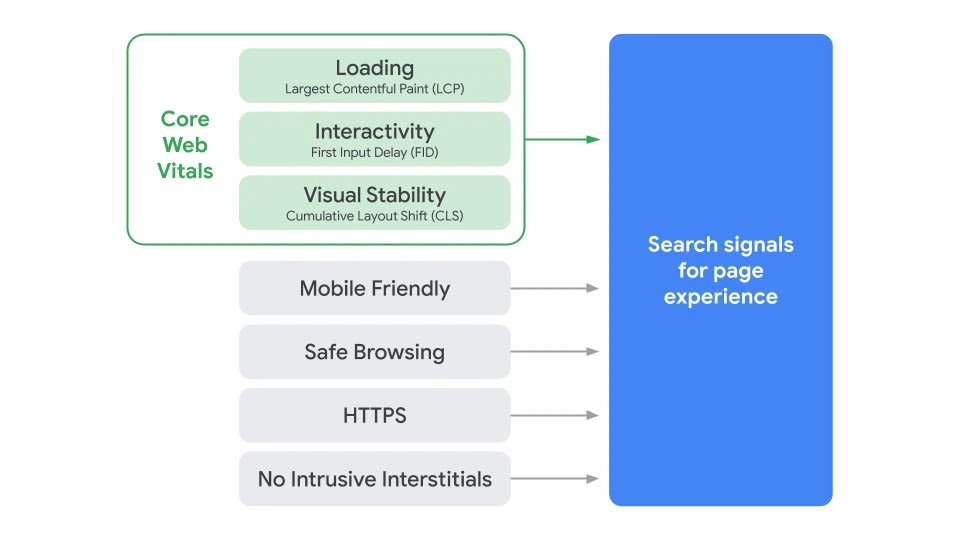
The 'Core' Web Vitals join the existing search signals: mobile-friendliness, safe-browsing, HTTPS, and no intrusive interstitials as seen in the graphic below from Google.
Understanding the Core Web Vitals
Before diving in, it is worth noting that the metrics that make up Core Web Vitals are expected to evolve over time. Google states that "these signals are not perfect and future improvements or additions should be expected."
Largest Contentful Paint (LCP)
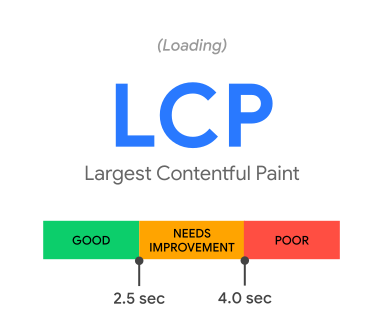
Largest Contentful Paint (LCP) measures when the "largest", or "main" piece of content has completely loaded and is visible, usually a hero image. Content refers to text, foreground images, background images, and elements. LCP complements First Contentful Paint (FCP), a metric that marks the initial web page loading experience. LCP calculates how quickly a user can see page content. Scores below 2.5 seconds are considered in the 'Good' range.
First Input Delay (FID) (Due to be replaced March 2024 by Interaction to Next Paint (INP))
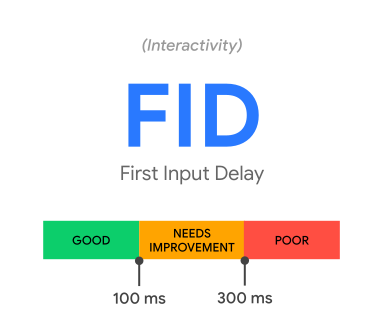
First Input Delay (FID) measures page interactivity: how long it takes for a page to respond to input from the user, such as a key press or a mouse click. Low FID scores ensure pages are usable. FID is a real-world metric that cannot be measured in the lab. The Total Blocking Time (TBT) metric found in Lighthouse is lab-measurable and correlates with FID to simulate real-world interactivity.
Cumulative Layout Shift (CLS)
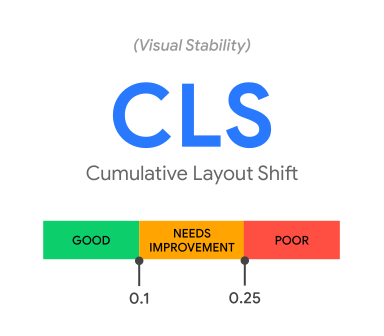
Cumulative Layout Shift (CLS) measures visual stability while the page is loading. This means that once displayed, a piece of content stays where it is; it does not jump around the screen as other content loads. Lower CLS scores mean that users are not experiencing unnecessary content shifts. CLS scores below 0.10 are 'Good'.
Understanding the rest of the Web Vitals
The Web Vitals metrics that are not part of the Core Web Vitals are Time to First Byte (TTFB), and First Contentful Paint (FCP). They provide additional ways to improve a web user’s experience, and help diagnose specific issues, either in the lab or in the field.
Time to First Byte (TTFB)
Time to First Byte is the time it takes for a user's browser to receive the first byte of page content.
First Contentful Paint (FCP)
First Contentful Paint (FCP) "measures the point from when a web page starts loading to when ANY content starts rendering on screen." The term 'Content' means text, images, <svg> elements, or non-white <canvas> elements. Just remember that FCP can be triggered very early in the page load, but may not necessarily deliver any visible content or information to the user.
Conclusion
Web Vitals are Google's attempt to unify the metrics webmasters use to measure the Page Experience of their site. With Core Vitals included in the ranking signals, site owners can see which performance measures Google treats as important. Measuring performance is the topic of our next few posts.