


Google recently confirmed that the Core Web Vitals will be included as search signals from May 2021. This means that, all else being equal, sites that score well on the Core Web Vitals are likely to rank ahead of those that don't.
A quick refresher of Web Vitals
The Core Web Vitals consist of three metrics, chosen to measure the experience of browsing a website. Here they are, along with the current thresholds for a 'Good', 'Needs Improvement', or 'Poor' rating:
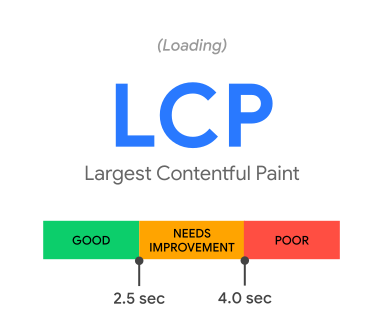
](/static/images/blog/fid.svg)
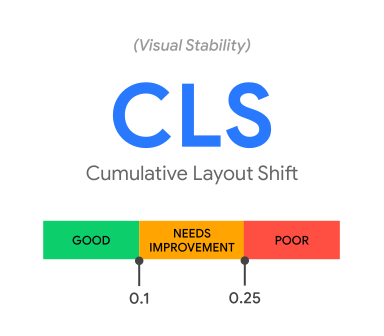
Web Vitals also defines several other metrics, including Time to First Byte (TTFB), and First Contentful Paint (FCP). While these aren't 'core' metrics, they are useful for diagnosing where performance problems come from. The target TTFB in the current version of Google Lighthouse is listed as 100ms, while poor is 600ms. FCP is good under 2s and poor over 4s.
How will Australian sites fare?
We asked a simple question: what percentage of Australian websites are ready for Web Vitals as a search signal, and what percentage could lose ground? To answer it, we ran them through our recently released Website Speed Comparison tool, which gathers Web Vitals metrics as part of its report.
Methodology
There are a lot of Australian websites, so we broke the analysis down by technology platform. We started with online stores running Magento.
We started with an initial list from BuiltWith of around 4000 domains. We then trimmed it down by removing development and demo sites, and sites returning an error, leaving a total of 2998. The list includes some of the largest retailers in Australia, including Harvey Norman, Sportsgirl, Philips and Dyson.
We then ran our competitor report for every one of them. The report was run from our Sydney office over a business-class internet connection. The test throttles the connection to simulate typical 4G mobile phone speeds, and uses a mobile phone user agent/screen size to view the mobile version of the site. We did not throttle CPU performance like Lighthouse does.
NOTE We're excluding First Input Delay in our results as Google defines First Input Delay (FID) as a real user measurement (RUM). FID measures the time taken for the website to respond to the first user interaction, such as clicking a link or button. Technically this interaction can happen any time after the first content appears in the browser; in practice, most people won't click something until after a page is visually complete, and this timing is highly variable. We do measure First Input Delay by simulating a click, but our interaction happens soon after the FCP, while content is still loading. That would cause more sites to fail the metric than would fail in real life, so we're excluding it from our calculations.
On to the results. We did not expect strong numbers, but the results were still worse than expected.
The results
The first check was for the number of websites that achieve a good rating in any of the Web Vitals metrics.
| Percentage of sites that are 'Good' | ||||
| TTFB (< 0.1s) | FCP (< 1s) | LCP (< 2.5s) | CLS (<.1) | |
|---|---|---|---|---|
| Result | 99 (3.3%) | 71 (2.37%) | 254 (8.47%) | 1074 (35.8%) |
CLS was the strongest result, which isn't a surprise. The remaining results are not encouraging: only 8.5% pass LCP. Let's see how many need improvement.
| Percentage of sites that 'Needs Improvement' | ||||
| TTFB (< 0.6s) | FCP (< 2s) | LCP (< 4s) | CLS (< .25) | |
|---|---|---|---|---|
| Result | 383 (12.7%) | 728 (24.3%) | 470 (15.7%) | 625 (20.8%) |
An additional 15.7% beat the 4s cut-off for LCP. That still means that 3/4 of Australian Magento stores take longer than 4s to visually load on a mobile device. Visualised, the numbers are not pretty.
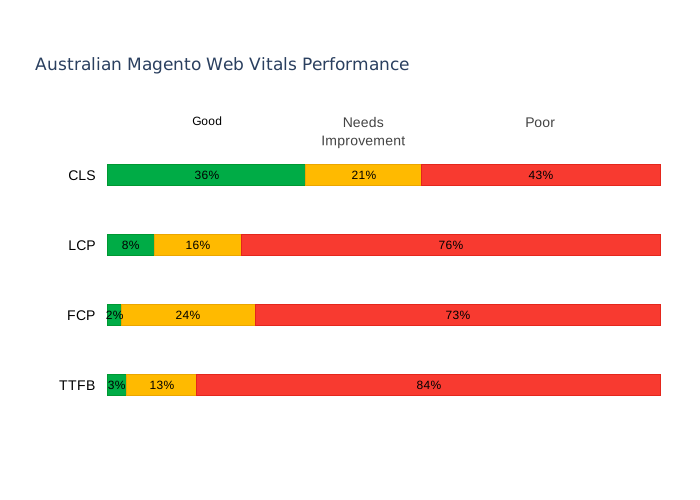
Australian Magento sites are likely missing potential sales. Recent performance studies show:
- The probability of a customer bouncing increases 90% if the page load time increases from 1s to 5s. (source Google)
- A 100 millisecond delay in load time can hurt conversion rates by 7%. (source Akamai)
The experience of our own Magento 1 clients and Magento 2 clients backs this up: improving website speed affects conversions and revenue.
Sites that pass all criteria
Of our 2998 websites, we only found 163 that pass Core Web Vital 'good' criteria. That's only 5.5%.
If we again relax to include 'needs improvement' that list grows to 520, or 17.3% of sites tested.
How you can test your site
Google provides online analytics that you can query via BigQuery. If you want to reproduce the report this analysis is based on and compare your website to your competitors, you can use the Peakhour.IO Website Speed Comparison report. We automatically discover your competitors, run them through Web Vitals, and graph the results.
Conclusion
If nothing changes, quite a few Australian Magento stores could lose search visibility in May 2021. The majority of sites don't use Magento 2's ability to cache dynamic pages, and if they do, they're often not serving optimal images.
Core Web Vitals becomes a search signal next year. For Magento teams, it is time to get ready.